How businesses can implement psychology mapping to transition into a premium category
In the current economic climate, the "middle market" has become a kill zone. Commoditization is aggressively eroding margins at the bottom, while agile, digitally native disruptors chip away at the top. For the modern enterprise, the transition to a premium category is no longer merely a branding exercise; it is a defensive moat and a critical capital allocation strategy essential for long-term survival.
This transition requires more than aesthetic upgrades or price hikes. It demands a fundamental re-engineering of the enterprise using Psychology Mapping—an analytical framework that visualizes the cognitive architecture of the consumer—anchored by robust Organizational Identity Architecture. By aligning operational governance with deep behavioral insights, organizations can engineer the intangible asset of "premium" status, insulating shareholder value against market volatility.
The strategic logic of premiumization
Escaping the commodity trap
Premiumization is widely misunderstood by boards and executive teams as a marketing tactic—a way to justify a higher logo placement or a glossy ad campaign. In reality, it is a financial imperative. Historical market data indicates that premiumization acts as a powerful hedge against inflation. Companies with high pricing power are able to pass through input cost increases to consumers without suffering a corresponding erosion in volume.
In a high-interest-rate environment, this capability is existential. According to analysis on global brand performance, premium and luxury segments often recover twice as fast as mass-market segments following economic downturns. This resilience stems from the fact that premium consumers are often insulated from the immediate shocks of inflation, making their demand curves less elastic.
Therefore, strategic capital allocation must prioritize initiatives that deepen the "moat" of perceived value. According to EY's capital allocation frameworks, effective allocation isn't just about organic capital expenditure (capex) or M&A; it requires integrating intangible value creation—specifically brand equity and customer loyalty—into the core corporate strategy.
To execute this, leaders must look beyond the external brand and focus on Organizational Identity Architecture. This involves structuring the company's internal reality—its culture, processes, decision rights, and values—to support the external promise of exclusivity. Without this structural integrity, any attempt at premium pricing is merely a façade that the market will quickly punish.
Applying the Three Horizons framework

To govern this transition effectively, CXOs should apply the standard Three Horizons model to their strategic roadmap. This prevents the common error of neglecting the core business while chasing a premium dream, or conversely, starving the innovation required to move upmarket.
Horizon 1 (Core): Defend the current mass-market position while optimizing margins through efficient Organizational Branding. The goal here is to generate the cash flow required to fund the premium transformation.
Horizon 2 (Emerging): Incubate premium sub-brands or "masstige" offerings. These serve as live laboratories to test higher price elasticity using targeted psychology maps without risking the main revenue stream.
Horizon 3 (Future): Fully operationalize a luxury ecosystem where value is derived from experience, identity, and belonging rather than pure utility.
Deconstructing the psychology map
Data-driven decision-making is standard in modern business, but the data used is often flawed. Traditional demographics—age, income, location—are insufficient for premium positioning. A 35-year-old investment banker and a 35-year-old artist may share an income bracket and a zip code, but they inhabit entirely different "Mental Maps." One may value scarcity and heritage, while the other values sustainability and innovation.
Beyond personas: Cognitive mapping
Cognitive mapping is the process of visualizing the internal logic a consumer uses to navigate their world. It reveals the heuristics—the mental shortcuts and subconscious rules—they use to assign value to objects and experiences.
To build a premium strategy, a business must map three distinct territories of the customer's mind:
The Routine Map: This visualizes how a product fits into daily friction points. For a mass-market product, success means removing friction. For a premium product, success often means adding ritual. For example, a pod coffee machine removes friction (mass), while a manual espresso press adds a ritual of craftsmanship (premium).
The Aspiration Map: This bridges the gap between who the customer is today and who they wish to become. Premium brands are rarely sold on what they do; they are sold on who they help the customer be. The map must identify the specific "ideal self" the customer is chasing—whether that is the "Savvy Investor," the "Cultured Traveler," or the "Responsible Parent."
The Anxiety Map: This identifies deep-seated fears such as irrelevance, obsolescence, social exclusion, or lack of control. Premium products often serve as antidotes to these anxieties. A luxury watch may soothe the anxiety of impermanence by promising something that "lasts forever."
For a business, the strategic goal is to insert the brand into the Aspiration Map while simultaneously resolving the Anxiety Map. This is the precise function of Organizational Branding: it is the deliberate calibration of the company’s public face to resonate with these deep-seated psychological maps.
When Organizational Branding successfully occupies this cognitive space, the product ceases to be a commodity. It becomes a Veblen good—a distinct economic category where demand paradoxically increases with price because the price itself signals social utility and exclusivity.
The neuroscience of value: Engineering "Psychological Ownership"
One of the most perplexing questions in economics is why consumers will pay a 500% markup for a handbag, a car, or a software subscription that offers only marginal functional improvements over a competitor. The answer lies in the neuroscience of Psychological Ownership.
Research by Pierce, Kostova, and Dirks suggests that consumers value an object significantly more when they feel a sense of ownership over it, even before legal ownership is transferred. This "endowment effect" creates a psychological switching cost that is far higher than any financial switching cost.
The three pillars of ownership
To engineer this premium stickiness, companies must build three specific triggers into their customer experience:
Control: The user must feel they can customize or influence the product. In software, this might look like modular dashboards or bespoke API integrations. In retail, it is made-to-measure tailoring. When a customer shapes the product, the product becomes an extension of the self.
Intimate Knowledge: The user must understand the "story" or origin deeply. This is why "farm-to-table" narratives or "open-source code" visibility works. It gives the consumer insider status. They know how the sausage is made, and that knowledge creates a bond of trust and superiority over those who don't know.
Self-Investment: The user has put effort into the brand relationship. This could be through a learning curve (e.g., mastering complex professional tools) or through loyalty progression. The more effort a customer invests, the more they value the relationship to justify that effort.
This level of intimacy cannot be achieved through advertising alone. It requires Organizational Identity Architecture that permeates every department. Product teams must build for customization (Control); supply chain teams must provide transparency (Intimate Knowledge); and customer success teams must gamify the experience (Self-Investment).
Decision Affect Theory
Executives must also account for Decision Affect Theory, which posits that people make choices based on the anticipated emotional payoff. In the premium sector, the tangible product is secondary to the feeling of the purchase.
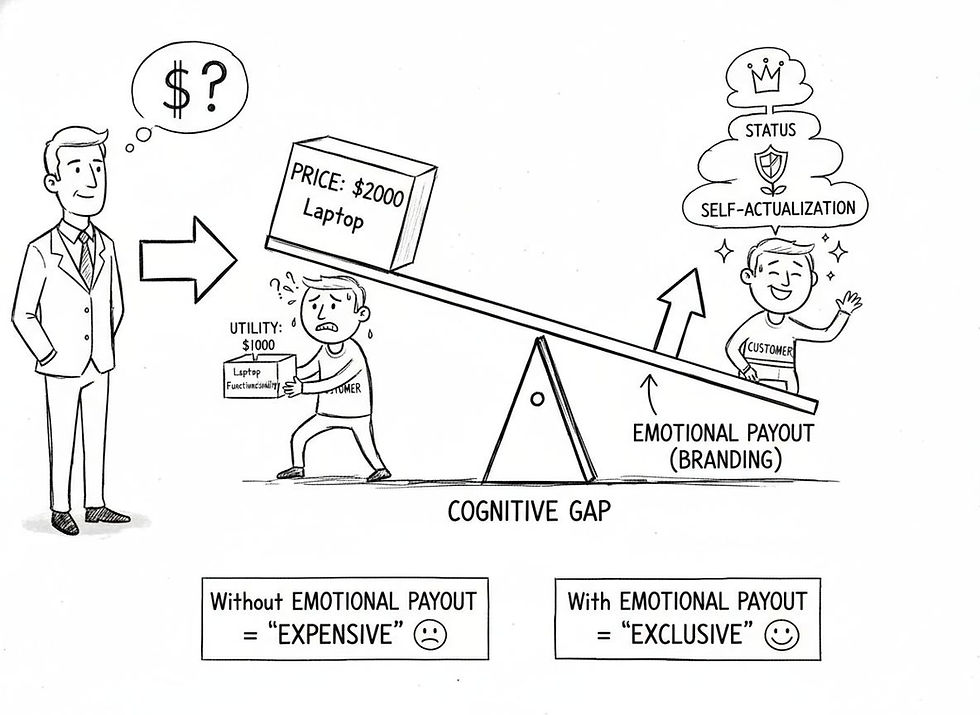
There is often a "Cognitive Gap"—a dissonance between the high price paid and the tangible utility received. A $2,000 laptop performs similarly to a $1,000 laptop. That gap must be bridged by an emotional payout: status, security, or self-actualization. If the Organizational Branding does not clarify this emotional payout, the customer will view the price as "expensive" rather than "exclusive."
Operationalizing the map: The governance playbook
Transitioning to premium is a high-risk maneuver. History is littered with "masstige" failures—brands that raised prices without raising value, leading to a collapse in trust. The difference between success and failure is often governance.
The "Premium Governance" checklist
Risk Management of Brand Dilution: In mass markets, growth is volume. In premium markets, ubiquity is death. Governance teams must monitor "Brand Dilution" metrics aggressively. If a premium brand becomes too accessible or appears in discount channels, it loses its Veblen status. Capital allocation decisions must prioritize brand integrity over short-term quarterly volume targets.
Silo-Busting via Identity Architecture: Psychology mapping cannot live in the Marketing department. It must be codified into the Organizational Identity Architecture. This ensures that the premium promise is not just a marketing slogan but an operational reality across Product, Finance, and HR.
Finance must approve higher budgets for packaging and support, understanding these are not costs but value drivers.
HR must hire for empathy and emotional intelligence, not just technical skill.
Product must prioritize finish and feel over feature bloat.
The Service Recovery Paradox: In premium categories, a failure (e.g., a delayed flight, a software bug) is an opportunity. The Service Recovery Paradox states that if a failure is resolved with overwhelming competence and empathy, customer loyalty actually increases beyond pre-failure levels. Premium organizations invest heavily in "recovery architecture"—empowering frontline staff with the budget and authority to solve problems instantly without managerial approval.
The touchpoint architecture: Mastering the Peak-End Rule
Most companies design their customer journey maps to be "frictionless." This is a mistake. Frictionless is forgettable. Premium experiences are not smooth; they are memorable.
Leveraging the Peak-End Rule
Nobel laureate Daniel Kahneman’s Peak-End Rule dictates that customers do not judge an experience based on the average of all moments. They judge it based on two specific moments:
The Peak: The most intense emotional moment (positive or negative).
The End: The final interaction.
If a consulting firm delivers excellent work for six months (average) but has a messy, bureaucratic contract termination (end), the client remembers the mess.
To transition to premium, businesses must engineer "Positive Peaks"—moments of surprise, delight, or extreme competence. This could be an unasked-for upgrade, a personalized insight delivered proactively, or a problem solved before the client knew it existed.
Equally important is the "Signature End." Organizational Branding requires that the offboarding or purchase conclusion be as curated as the onboarding. A luxury car purchase doesn't end with handing over keys; it ends with a tutorial and a celebration. A B2B software contract shouldn't end with an invoice; it should end with a value-realization report.
Measuring the intangible: "Share of Psyche"
How do you manage what you cannot measure? Traditional KPIs like Market Share and Customer Satisfaction (CSAT) are blunt instruments for premium brands. A high CSAT score often just means "you met basic expectations." In the premium world, meeting expectations is the baseline, not the goal.
The new executive dashboard
To steer a premium transition, executives need a new set of metrics:

Net Promoter Score (NPS) Deconstructed: Do not just look at the score. Analyze the text of the feedback. Focus on "Promoters" who cite emotional reasons for their advocacy ("I love them," "I trust them") versus functional reasons ("It was cheap," "It arrived on time"). Emotional promoters are the bedrock of premium value.
Price Elasticity of Demand: A successful transition is marked by decreasing price sensitivity. If you raise prices by 10% and volume drops by 10%, you are a commodity. If you raise prices by 10% and volume drops by only 2%, you have achieved premium pricing power.
Share of Psyche: This is a qualitative measurement of how central the brand is to the customer's identity. This can be assessed through depth interviews and sentiment analysis. Does the customer view the brand as a vendor (replaceable) or a partner (essential)?
Referral Velocity: In premium markets, your customers are your sales force. Track the speed and quality of inbound referrals. High-net-worth individuals and premium businesses rely heavily on peer validation. An increase in organic, high-quality referrals is the surest sign that your Organizational Identity Architecture is resonating.
The Board’s mandate
The shift to a premium category is not a pivot; it is an evolution of the business model. It requires the Board to sanction a shift from volume-based metrics to value-based metrics. It demands that the CEO looks at the customer not as a wallet to be emptied, but as a psyche to be understood.
By implementing Psychology Mapping within a defined Organizational Identity Architecture, organizations do not just "sell" products. They engineer experiences that align with the deepest cognitive structures of their market. In doing so, they secure the ultimate competitive advantage: they become irreplaceable.


