Why the Most Defensible Businesses Are Built on Knowledge, Not Just Products
The paradox confronting enterprises in 2026 is stark: organizations invest billions in products, platforms, and innovations that competitors replicate within months, yet systematically underinvest in the one asset that cannot be copied—the knowledge architecture that enables those products to exist, evolve, and create defensible value. Poor data quality alone costs organizations an average of $12.9 million annually, while 92% of enterprises agree that access to fast, accurate information from unstructured content is vital to their business—yet only 26% report broad BI use, and only 21% of employees feel capable of using data appropriately. The financial exposure is extraordinary.
This underinvestment stems from a conceptual failure: treating knowledge management as a support function rather than as the architectural foundation of competitive advantage. When knowledge is relegated to IT departments, document repositories, or training programs, it becomes static, fragmented, and isolated from the decision-making processes it should inform. The consequences are measurable and severe. Between 70% and 85% of AI initiatives fail to meet expected outcomes, with 42% of companies abandoning most AI initiatives in 2025, up from 17% in 2024. The barrier is not technological capability—MIT research reveals that 95% of corporate AI projects fail not from infrastructure deficits but from the absence of learning-capable knowledge systems that can capture, contextualize, and adapt organizational intelligence. As one MIT researcher observed in analyzing enterprise AI deployments, "Most GenAI systems do not retain feedback, adapt to context, or improve over time. The core barrier to scaling is not infrastructure, regulation, or talent. It is learning."
The thesis of this analysis is unequivocal: in 2025 and beyond, competitive defensibility emerges not from product superiority—which can be replicated—but from knowledge architecture that cannot be copied, purchased, or rapidly assembled. Organizations that engineer knowledge as strategic infrastructure, building systems that capture tacit expertise, enable continuous learning, and accelerate decision-making velocity, create competitive advantages that compound over time. Those that treat knowledge as a repository create liabilities that compound losses. This is the knowledge architecture imperative: Intellectual Asset Creation that transforms static information into adaptive intelligence, converting organizational learning into market dominance that products alone can never deliver.

01
The Revenue Exposure — When Knowledge Fragmentation Destroys Enterprise Value
The financial cost of fragmented knowledge systems is neither theoretical nor marginal. Poor knowledge management impacts an average of 25% of annual revenue through duplicated work, delayed decisions, customer churn from inconsistent service, and competitive losses from slower innovation cycles. Yet executives consistently underestimate this exposure because knowledge failures manifest as operational inefficiencies rather than as line-item expenses. A sales team that cannot access competitive intelligence loses deals without a "knowledge management failure" appearing on the P&L statement. An engineering team that rebuilds solutions already developed elsewhere incurs project delays, not visible knowledge costs. The enterprise hemorrhages value through a thousand small inefficiencies that aggregate into strategic vulnerability.
The mechanism is straightforward but insidious. 36% of organizations use three or more knowledge management tools, while 12% use between two and three, and 31% are not even sure how many tools they have in place. This fragmentation creates information silos where critical knowledge becomes inaccessible precisely when decisions require it. Engineers cannot find design specifications. Customer service representatives lack access to product updates. Sales teams operate with outdated competitive positioning. Each silo represents not merely inconvenience but competitive handicap—organizations with integrated enterprise intelligence make decisions 27% faster and operate with 20% lower costs than those relying on fragmented systems. The speed differential compounds: faster decision cycles enable faster learning, which accelerates subsequent decision cycles, creating exponential divergence between knowledge-enabled organizations and their knowledge-poor competitors.
The Fragmentation Tax Is Exponential, Not Linear: A global telecommunications company discovered through internal audit that engineers were spending 18% of their time searching for technical documentation that existed but was scattered across departmental systems. The direct productivity loss was quantifiable—thousands of engineering hours wasted annually. The strategic loss was existential: while engineers searched for existing solutions, competitors who had unified knowledge systems were iterating new solutions, creating an innovation velocity gap that product investment alone could not close. The company implemented a unified knowledge platform with contextual search, role-based access, and automated documentation capture. Within 18 months, time-to-market for new features decreased by 31%, not from engineering process changes but from eliminating knowledge friction that had been invisible on financial statements yet catastrophic for competitive positioning.
The revenue exposure extends beyond operational efficiency to strategic capability. When knowledge remains fragmented, organizations cannot leverage their collective intelligence for competitive advantage. Customer insights captured by sales teams never reach product development. Technical innovations discovered by one engineering team remain unknown to others facing identical challenges. Market intelligence gathered by regional offices fails to inform corporate strategy. The enterprise operates as disconnected units rather than as a unified intelligence system, sacrificing the network effects that would multiply the value of individual knowledge assets. 39% of organizations report improved business execution including better decision-making and faster time-to-market from effective knowledge management, demonstrating that knowledge unification creates measurable enterprise value. The organizations that fail to unify knowledge do not merely accept operational inefficiency—they surrender the compound competitive advantages that integrated intelligence creates.
02
The AI Implementation Paradox — When Technological Investment Fails Without Knowledge Infrastructure
The acceleration of AI adoption has exposed a fundamental truth that enterprises are reluctant to acknowledge: technology investment without knowledge infrastructure produces spectacular failure rates. 70-85% of AI initiatives fail to meet expected outcomes, with the percentage of companies abandoning most AI initiatives before production surging from 17% to 42% year-over-year. The average organization scraps 46% of AI proof-of-concepts before reaching production, and only 6% of organizations qualify as "AI high performers" achieving 5%+ EBIT impact. These failure rates are not anomalies—they represent systematic organizational incapacity to support advanced technology with the knowledge systems required to make that technology valuable.
The pattern is consistent across implementation attempts. MIT research analyzing 150 interviews, 350 employee surveys, and 300 public AI deployments found that only 5% of AI pilot programs achieve rapid revenue acceleration, while the vast majority stall and deliver no measurable P&L impact. The research identified the core constraint: "Most fail due to brittle workflows, lack of contextual learning, and inability to improve over time. The core barrier to scaling is not infrastructure, regulation, or talent. It is learning." Organizations invest in AI capabilities without first establishing the knowledge architectures that would enable those capabilities to learn, adapt, and compound value. The result is technology deployed into information vacuums, unable to access the institutional knowledge, contextual understanding, and feedback loops necessary for operational utility. 46% of organizations that invested in generative AI reported that no single enterprise objective saw strong positive impact from that investment—not because the technology failed, but because the knowledge infrastructure required to operationalize the technology did not exist.
Technology Amplifies Architecture, Not Absence: A multinational financial services firm invested $80 million in AI-powered risk assessment tools designed to analyze market exposures and automate compliance reporting. The tools were technically sophisticated, the implementation professionally executed, the vendor highly credible. Within six months, the initiative was quietly shelved. The failure was not technological but architectural: the AI models required access to structured historical data, contextual market intelligence, and institutional knowledge about risk tolerance that existed in fragmented systems, tribal knowledge, and undocumented practices. Compliance officers had tacit understanding of regulatory interpretation that was never captured. Risk analysts maintained Excel models with critical assumptions never codified. Market intelligence was scattered across email chains and presentation decks. The AI had computational power but no knowledge foundation to compute upon. The firm subsequently invested in knowledge architecture first—building unified data governance, capturing tacit expertise through structured interviews, creating accessible knowledge bases documenting institutional practices. Two years later, they redeployed similar AI tools with radically different outcomes: risk assessment cycles shortened by 58%, compliance reporting automated for 73% of routine filings, and false positives reduced by 64%. The technology had not changed. The knowledge infrastructure had.
The economic magnitude of this failure is staggering. Companies spent $37 billion on generative AI in 2025, up from $11.5 billion in 2024, representing a 3.2x year-over-year increase. With failure rates exceeding 70%, this represents tens of billions in wasted investment—capital deployed into technology that cannot function without the knowledge systems organizations failed to build. The implication is profound: competitive advantage in the AI era does not accrue to organizations with the most advanced technology but to those with the most sophisticated knowledge architectures. Organizations implementing AI solutions report ROI typically materializing within 12-24 months—but only when knowledge infrastructure exists to support implementation. Without that infrastructure, AI investments produce neither returns nor operational value, merely expensive demonstrations of what technology cannot accomplish in the absence of Intellectual Asset Creation that transforms organizational knowledge into machine-accessible intelligence.
03
The Decision Velocity Imperative — When Knowledge Architecture Becomes Competitive Clock Speed
In markets where competitive advantage increasingly derives from adaptation speed rather than from resource scale, decision velocity has become the primary determinant of enterprise performance. Organizations with integrated enterprise intelligence make decisions 27% faster than those relying on fragmented knowledge systems—a speed differential that compounds across thousands of daily decisions to create exponential competitive divergence. Conversational AI and embedded analytics can cut time-to-insight from days to minutes, transforming decision-making from periodic strategic exercises into continuous operational advantages. The organizations that engineer knowledge for velocity do not merely decide faster—they learn faster, adapt faster, and obsolete competitors who still operate on quarterly review cycles when markets demand daily recalibration.
The mechanism through which knowledge architecture accelerates decisions is architectural, not merely technological. Traditional decision-making requires sequential steps: identify the question, locate relevant data, aggregate information from multiple sources, contextualize findings, analyze implications, and reach conclusions. Each step introduces friction and delay. Knowledge architecture collapses these steps by preemptively structuring information for decision contexts, embedding intelligence where decisions occur, and eliminating search friction that consumes decision capacity. 35% of organizations implementing effective knowledge management saw improvements in employee performance including productivity, learning, and collaboration, demonstrating that knowledge accessibility directly enhances operational capability. When knowledge systems surface relevant intelligence proactively rather than requiring manual retrieval, decision latency approaches zero—enabling real-time responses to market signals that competitors with traditional knowledge systems cannot even detect until quarterly reports aggregate delayed data.
Decision Velocity Is Cumulative, Not Episodic: A consumer electronics manufacturer competing in markets with 6-month product cycles faced existential pressure from rivals who released competitive responses within weeks of new product launches. The company's engineering, marketing, and supply chain teams each maintained separate knowledge systems, requiring coordination meetings to align decisions. By the time consensus emerged, market windows had closed. The company implemented a unified knowledge platform with role-based dashboards that gave product managers real-time visibility into engineering constraints, supply chain capacity, and competitive intelligence without requiring cross-functional meetings. Marketing could see component availability. Engineering could access customer feedback. Supply chain could monitor competitor launches. Decision cycles collapsed from weeks to days—not from process reengineering but from eliminating knowledge retrieval friction. Within 18 months, the company reduced time-to-market by 41% and increased successful product launches by 67%. Competitors with superior engineering capabilities but fragmented knowledge systems could not match the velocity advantage that knowledge architecture created.
The strategic implication extends beyond individual decision speed to organizational learning velocity. When knowledge systems capture decision outcomes, document rationale, and preserve institutional memory, each decision becomes training data for future decisions. Organizations with mature knowledge architectures do not merely decide faster—they improve faster, building decision quality that compounds over time. 35% of organizations reported higher satisfaction and engagement among both employees and customers from effective knowledge management, suggesting that knowledge-enabled decision-making creates stakeholder value beyond operational efficiency. Statistics indicate that online learning can lead to a 50% increase in employee retention and a 15-25% improvement in employee performance, demonstrating that knowledge systems not only accelerate decisions but also enhance the decision-making capability of the workforce executing those decisions. The compound effect is profound: organizations that treat knowledge as infrastructure for decision velocity create self-reinforcing cycles where faster decisions generate more learning, which enables faster subsequent decisions, progressively widening competitive gaps that product innovation alone cannot bridge.

04
The Tacit Knowledge Crisis — When Institutional Intelligence Walks Out the Door
The greatest knowledge vulnerability facing enterprises is invisible on balance sheets yet catastrophic for competitive capability: the loss of tacit knowledge when experienced employees depart. Explicit knowledge—documentation, procedures, databases—can be captured and transferred. Tacit knowledge—the intuition, judgment, contextual understanding, and pattern recognition that enable expert performance—exists only in human expertise and evaporates when that expertise leaves the organization. Statistics show that knowledge-based software can lead to a 50% increase in employee retention, suggesting that knowledge systems not only preserve expertise but also retain the employees who possess it. Yet most organizations lack systematic processes for capturing tacit knowledge before departure, treating institutional intelligence as disposable rather than as the strategic asset that creates competitive advantages products cannot replicate.
The economic impact of tacit knowledge loss is severe but diffuse, manifesting as degraded decision quality rather than as discrete financial events. When a sales director with 15 years of customer relationship intelligence departs, explicit knowledge transfers through CRM handoffs—contact lists, deal histories, contract terms. Tacit knowledge disappears: which customers make decisions emotionally versus analytically, which procurement officers respond to data versus relationships, which competitive threats require immediate response versus strategic patience. The replacement sales director operates with data but without wisdom, making statistically rational decisions that ignore contextual intelligence the organization just lost. Customer relationships deteriorate not from incompetence but from knowledge absence. The P&L statement shows lost revenue. The root cause—tacit knowledge evaporation—never appears in post-mortems because it is invisible, unquantified, and systematically ignored until competitive consequences become undeniable.
Institutional Memory Is Competitive Memory: A pharmaceutical company lost its Chief Scientific Officer after 22 years leading drug development programs. The CSO had overseen 14 FDA approvals, navigated countless regulatory challenges, and developed deep institutional knowledge about which research paths led to viable therapies versus expensive dead ends. Explicit knowledge transferred smoothly—research protocols, clinical trial data, regulatory filings. Tacit knowledge vanished: which early-stage compounds showed patterns associated with future adverse events, which research teams had cultures that accelerated development versus created bureaucratic delays, which FDA reviewers required which communication approaches. The replacement CSO, highly credentialed and technically expert, made decisions that were scientifically sound but contextually naïve. Two compounds advanced to Phase III trials that the former CSO would have terminated at Phase I based on pattern recognition never documented. The trials failed, costing $180 million and 4 years. The company subsequently implemented a tacit knowledge capture program using structured interviews, scenario-based debriefs, and apprenticeship models that documented expertise before departure. When the next senior scientist retired, institutional intelligence transferred intact. The knowledge architecture prevented the hemorrhaging of competitive capability that had previously been considered inevitable.
The solution requires systematic conversion of tacit knowledge into explicit, accessible forms—not through documentation mandates, which produce compliance artifacts rather than useful intelligence, but through knowledge capture integrated into operational workflows. 38% of knowledge management teams use AI to recommend content or knowledge assets, suggesting that AI-enabled systems can surface and structure tacit expertise that would otherwise remain undocumented. When knowledge systems prompt experts to document decision rationale, capture lessons learned, and explain judgment calls, tacit intelligence gradually converts into institutional knowledge accessible to successors. 80% of managers experience pain points when pulling data to make decisions, often because critical knowledge resides in departing employees rather than in accessible systems. Organizations that engineer Intellectual Asset Creation to systematically capture and preserve tacit expertise build knowledge moats that deepen over time, accumulating competitive intelligence that cannot be rapidly assembled by rivals recruiting individual experts but lacking the institutional knowledge architecture to retain and leverage that expertise across organizational generations.
05
The Learning System Imperative — When Knowledge Architecture Enables Continuous Adaptation
The fundamental distinction between knowledge repositories and knowledge architectures lies in their relationship to organizational learning. Repositories store information statically, providing access to historical knowledge without mechanisms for continuous improvement. Architectures enable learning systems, capturing feedback, adapting to outcomes, and progressively improving decision quality through iteration. MIT research on AI implementation found that systems fail when they "do not retain feedback, adapt to context, or improve over time"—the same failure mode afflicts knowledge management systems that treat knowledge as static content rather than as dynamic intelligence requiring continuous refinement. Organizations that engineer knowledge as learning systems create compound advantages where every decision, project, and customer interaction generates intelligence that improves subsequent performance.
The architectural requirements for learning systems extend beyond storage and retrieval to include feedback loops, outcome tracking, and pattern recognition that identify which knowledge improves performance versus which knowledge misleads or becomes obsolete. 44% of knowledge management professionals believe that generative AI is necessary to create new artifacts and content, recognizing that AI capabilities can accelerate knowledge synthesis and pattern detection that would be impossible through manual curation. When knowledge systems connect decisions to outcomes, document what worked versus what failed, and surface patterns across similar situations, organizational learning becomes systematic rather than anecdotal. Best practices propagate automatically. Failures generate insights rather than merely disappointment. Institutional intelligence compounds as knowledge systems accumulate not just information but validated understanding about what drives successful outcomes in specific contexts.
Learning Systems Compound While Repositories Stagnate: A global consulting firm maintained comprehensive knowledge repositories documenting methodologies, case studies, and client deliverables. Partners could search past projects and adapt previous work to new engagements. Yet the firm consistently underperformed competitors who had fewer documented resources but better client outcomes. The issue was architectural: the knowledge repository provided access to past solutions without feedback on which approaches worked versus which failed, which client contexts required customization versus standardization, which methodologies generated repeat business versus one-time engagements. The firm reimplemented knowledge management as a learning system with structured project retrospectives, outcome tracking linked to methodologies, and AI-powered pattern recognition identifying success factors across engagements. Within two years, client satisfaction increased 34%, partner productivity improved 28%, and new business from existing clients grew 41%—not from new methodologies but from systematically learning which existing approaches worked in which contexts and adapting knowledge to reflect that understanding. Competitors with larger knowledge repositories but static architectures could not match the adaptive capability that continuous learning created.
The strategic advantage of learning systems becomes exponential over time. Organizations starting with similar knowledge bases but different architectures diverge rapidly: those with static repositories accumulate information that gradually becomes obsolete, while those with learning systems accumulate validated intelligence that improves continuously. 35% of organizations saw gains in customer support including reduced service volumes and quicker resolutions from effective knowledge management, demonstrating that knowledge systems optimized for learning improve operational performance beyond information access. Companies that master real-time "data in motion" outcompete those stuck with "data at rest", recognizing that knowledge value derives from continuous adaptation rather than from static accuracy. The organizations that engineer knowledge architectures as learning systems rather than as information repositories create competitive advantages that compound with every decision, customer interaction, and project outcome, building institutional intelligence that becomes progressively more sophisticated while competitors' knowledge bases ossify into historical artifacts documenting what used to work rather than what works now.
06
The Governance Imperative — When Knowledge Quality Determines Strategic Reliability
Knowledge architecture without governance produces information chaos, where accessibility without accuracy undermines rather than enhances decision quality. 71% of organizations now report having a data governance program in place, up from 60% in 2023, recognizing that knowledge value depends on trustworthiness as much as availability. 62% identify data governance as one of the top challenges when using AI, understanding that AI amplifies governance failures by propagating inaccurate information at scale. When knowledge systems lack governance—defining ownership, establishing review cycles, enforcing version control, documenting provenance—they devolve into unreliable repositories where users cannot distinguish authoritative information from obsolete content, creating decision risks that outweigh accessibility benefits.
The governance challenge intensifies with knowledge scale and distribution. Centralized knowledge with clear ownership can maintain quality through editorial oversight. Distributed knowledge generated by thousands of employees across geographies, departments, and systems requires architectural governance—automated workflows that enforce quality standards, version control systems that prevent conflicting information, provenance tracking that documents knowledge sources, and deprecation processes that retire obsolete content before it misleads decision-makers. Poor data quality limits the effectiveness of AI tools, especially in knowledge systems that rely on accurate inputs to deliver helpful answers—governance failures do not merely create inconvenience but destroy the reliability of decision systems dependent on knowledge accuracy. Organizations that implement governance as architectural constraint rather than as manual process build knowledge systems where quality is engineered into workflows rather than depending on user discipline that inevitably degrades under operational pressure.
Governance Is Architectural, Not Administrative: A multinational manufacturing company implemented a knowledge platform accessible to 40,000 employees across 80 facilities. Initial adoption was enthusiastic—teams documented procedures, shared best practices, uploaded technical specifications. Within 18 months, the platform became unusable: multiple conflicting versions of critical procedures, obsolete safety protocols competing with updated standards, undocumented engineering specifications that newer engineers assumed were authoritative. The governance failure was architectural: the platform enabled content creation without ownership assignment, version control, or review workflows. The company redesigned the architecture with structural governance—automated ownership assignment, mandatory review cycles triggered by content age, version control requiring explicit deprecation of superseded content, and AI-powered conflict detection that flagged inconsistencies for resolution. Quality improved dramatically not from increased user discipline but from governance engineered into workflows. Within two years, the platform achieved 94% user trust scores compared to 38% under the previous architecture. Decision quality improved as knowledge reliability increased, demonstrating that governance is not administrative overhead but strategic imperative for Intellectual Asset Creation that creates defensible competitive advantages through reliable institutional intelligence.
The strategic implication extends beyond information accuracy to organizational trust in knowledge systems. When governance failures make knowledge unreliable, users revert to tribal knowledge, email chains, and informal networks—exactly the fragmentation that knowledge architecture should eliminate. AI-powered insights only work when you trust the underlying data, and trust requires governance that ensures accuracy, currency, and reliability. 58% of executives and managers still disperse information through email rather than knowledge databases, often because governance failures have destroyed confidence in database accuracy. Organizations that engineer governance into knowledge architecture—treating quality as structural requirement rather than as user responsibility—build knowledge systems that earn the trust required for adoption, creating network effects where increasing usage improves knowledge quality rather than degrading it. The competitive advantage emerges not from having more knowledge but from having more reliable knowledge, enabling confident decisions that competitors with ungoverned knowledge systems cannot risk making.
The Knowledge Architecture Imperative Is the Competitive Imperative
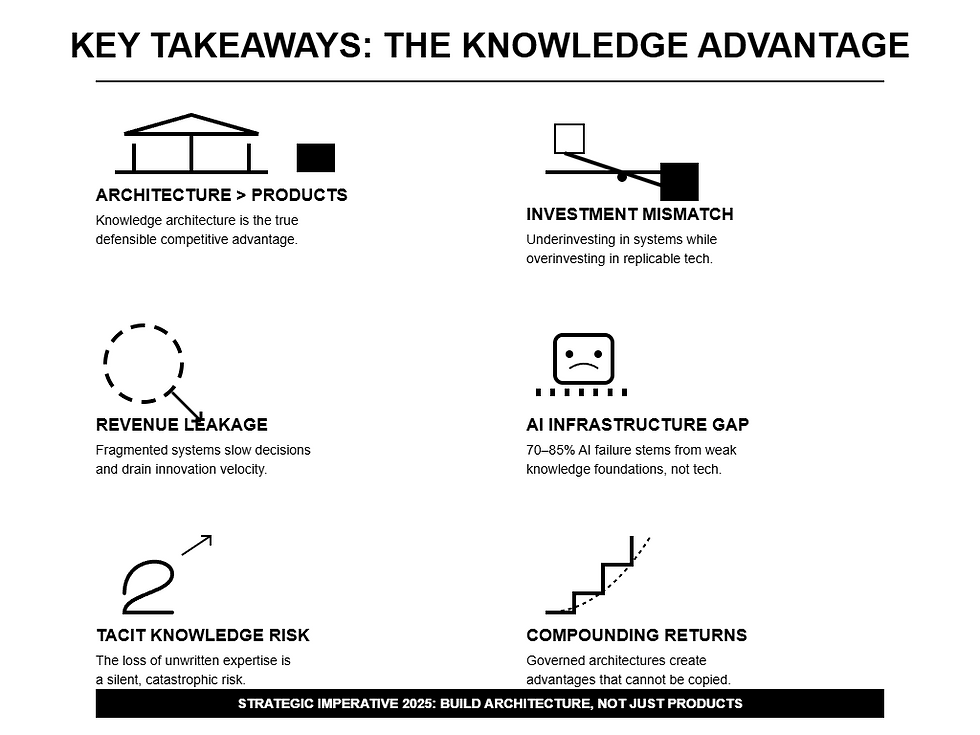
The central insight emerging from enterprise knowledge failures is unambiguous: competitive defensibility in 2025 and beyond derives not from product superiority—which competitors replicate—but from knowledge architectures that enable organizational capabilities competitors cannot assemble, purchase, or rapidly deploy. Organizations that engineer knowledge as strategic infrastructure rather than as support function build compound advantages where decision velocity, learning systems, institutional memory, and governance quality create exponential performance divergence that product innovation cannot overcome. The organizations treating knowledge management as IT responsibility accept competitive exposure that financial statements never quantify but market position inevitably reveals.
The architectural imperative demands systematic transformation of how enterprises conceptualize, structure, and operationalize knowledge. This is not technology deployment—implementing platforms without knowledge architecture produces the 70-85% AI failure rates currently devastating enterprise technology investments. This is strategic engineering: designing governance frameworks that ensure knowledge reliability, building learning systems that compound organizational intelligence, implementing capture processes that preserve tacit expertise, creating decision architectures that collapse latency from days to minutes, and establishing knowledge operations as core competency rather than as administrative function. Companies that moved early into GenAI adoption report $3.70 in value for every dollar invested, with top performers achieving $10.30 returns per dollar—but these returns accrue to organizations with knowledge architectures supporting AI deployment, not to those deploying AI into information vacuums.
The forward-looking implication is profound: the next decade of competitive advantage will be determined not by who has better products but by who has better knowledge architectures enabling those products to evolve faster, serve customers more precisely, adapt to market shifts more rapidly, and leverage institutional intelligence more comprehensively. Organizations with high business intelligence adoption rates are 5 times more likely to make faster and better-informed decisions, creating speed advantages that compound into insurmountable competitive positions. Products can be copied. Knowledge architectures cannot—they require years to build, accumulate value through organizational learning, and create network effects where increasing knowledge improves decision quality which generates more knowledge. The enterprises that recognize this reality and invest accordingly will dominate markets. Those that continue treating knowledge as support function rather than as strategic infrastructure will watch competitors with inferior products but superior knowledge systems progressively capture market share through operational advantages that product development cannot counter. The knowledge architecture imperative is not optional enhancement—it is existential requirement for organizations intending to remain competitive in markets where Intellectual Asset Creation has become the primary determinant of defensible advantage.


